Bienvenue / Welcome to Nelumbo - Le Journal !

Ce blog met à votre disposition des informations sur l'univers culturel et sur le monde de la recherche et de la science. Vous trouverez ici des annonces à propos de séminaires ou de conférences à venir, sur la recherche en sciences sociales (plus particulièrement en Asie du Sud-est), sur des évènements scientifiques et culturels, propositions d'emploi, des appels à contribution, etc.
Pour recevoir les actualités de Nelumbo, devenez membres ou souscrivez au RSS.
Contactez-moi pour toute requête, proposition de publication d'un article, suggestion d'un évènement, ou autre commentaire. Bonne visite !
---
This blog's purpose is to inform you about the cultural studies, research and science world. Nelumbo is generally focused on issues related to archaeology, history, and culture in Southeast Asia. It's also a place for posts and ads about seminars or conferences, on research in social sciences (particularly in South-East Asia), on scientific and cultural events, publications, calls for papers, jop posts, etc.
Feel free to use the search box above, subscribe for RSS, or become member.
Contact me for any request, recommend an article or submit contribution, suggest event, or something else. Corrections, comments and questions are most welcome. Have a good time !
Affichage des articles dont le libellé est bouddhisme. Afficher tous les articles

1 déc. 2010

[Article] Mrauk U Pagodas Damaged by Railroad Construction.

November 24, 2010  | By Khin Oo Thar

The on-going construction of the Sittwe-Amm-Minbu railroad is damaging important cultural heritage sites in Mrauk U, a well-known site of ancient pagodas and buildings in Arakan State, according to concerned local residents.
"Although we have called for an end to this project, they haven't complied,” a Mrauk U resident told The Irrawaddy. He said damage to some pagodas has been covered over with earth. The railroad construction started on Nov. 7.
The construction project has resulted in damage or destruction of ancient pagodas, stupas, walls, strongholds, religious libraries, moats, and city walls, said local sources.
"Their biggest concern is people who might take pictures or videos of this destruction," said one observer.
Local influential residents, monks and members of the public have submitted a formal request to local authorities to stop the construction, but the project has continued unabated, sources said.
On Tuesday, a letter was sent to the cultural minister with a copy to Snr-Gen Than Shwe and regional authorities, said a local monk.
"It is not only about destruction of our ancient heritage but also our own religious structures. It's a shame for us as Buddhist, destroying Buddha images and pagodas," he told The Irrawaddy.
rauk U is a well-known site of ancient pagodas and buildings in Arakan State. (Source: http://www.routard.com)

1 nov. 2010

[Bourse ] ACM Research Fellowship Grant | Buddhist Art

The Asian Civilisations Museum (ACM) in Singapore invites scholars specialising in Buddhist art, Avalokiteshvara or visual culture to apply for a 12-month research fellowship. The award period for the 2011-12 fellowships will commence from April 2011 through March 2012. The applications will be screened by a committee of eminent scholars and will be administered by the Research and Publication Unit (RPU) of ACM.

Background

The research fellowships were first offered in 2009. They are planned to generate in-depth study, documentation and thought leading publications on specialised aspects of Asian cultures. This is in line with the aim of the ACM to be a centre of research in Asian cultures and arts. Since its opening at the Empress Place in 2003, the ACM has established a reputation in the international museum arena for its excellent gallery displays and exhibitions. The ACM is undertaking to develop its research potential in the field of Asian archaeology, art history and material culture, so as to become the regional hub synonymous with excellent research projects and publications in the field.

Applications close 15 January 2011. 
For enquires, please contact us at nhb_acm_rpu@nhb.gov.sg.

14 sept. 2010

[Article] Indonesian Academic Claims Borobudur Temple Is Islamic

September 02, 2010 | Jakarta Globe

Jakarta. An obscure group led by an academic from a respected Islamic university in Indonesia is reportedly set to petition the Constitutional Court to declare that the Borobudur Temple in Central Java belongs to Islam.
Kompasiana.com reported that researchers from the Islam and Ancient History Study Institution, led by Fahmi Basya, an Islamic mathematics lecturer from Syarif Hidayatullah Islamic State University in Jakarta, claimed they had solid proof the Buddhist temple was built by the Prophet Solomon’s “genie soldiers.”
Solomon, who according to the Hebrew Bible was a king of Israel, is known as the prophet Sulayman in the Koran.
According to the article, the researchers had connected Borobudur with the Kraton Ratu Boko (Queen Boko’s Palace) near the Hindu temple Prambanan in Central Java, claiming that Boko was actually another name for Queen Balqis, the wife of Sulayman.
Buddhist monks pray at Borobudur Temple in Central Java. A group of Indonesian researchers claim that the temple was built by Solomon, as Islamic prophet. (Antara Photo/Anis Efizudin)
[Read the full article here]

1 août 2010

[Internet] Candi di Indonesia - [Buddhist and Hindu] Temples of Indonesia

http://candi.pnri.go.id/
Perpustakaan Nasional Republik Indonesia / National Library of the Republic of Indonesia, Jakarta, Indonesia


Self-description:
"This site is developed [2000-2005 ed.] by the National Library of the Republic of Indonesia, particularly offered to the Congress of South East Asian Libraries (CONSAL), [http://www.consal.org/] [...]. Temples are mentioned as the theme for the existence of the temples in Indonesia has close relationship with the history of this nation and the state of Indonesia. The [Buddhist and Hindu] temples spreading throughout the archipelago are incredible cultural heritage and highly appreciated; hence, their existence should be broadly well known to the societies."


24 juil. 2010

[Article] Festivities celebrate temple

08 July 2010 | Phnom Penh Post | Vong Sokheng

Preah Vihear province
During the ceremony, Buddhist monks chanted blessings while performers beat traditional Khmer drums representing the warrior ethic of the Angkorian empire.
In an address, Chea Dara, deputy commander of the Royal Cambodian Armed Forces, paid tribute to the “smart leadership” of Prime Minister Hun Sen, which he said had helped protect the temple from Thai occupation.
“We are determined to protect Preah Vihear temple and its sovereignty according to the policy of Prime Minister Hun Sen, who ordered us not to invade 1 millimetre into Thailand, and also not to allow our sovereignty to be invaded by 1 millimetre either,” he said.
The temple’s July 2008 listing by UNESCO was highly controversial in Thailand, and triggered a rapid troop buildup along the border with Cambodia. The standoff has been punctuated by a series of small-scale clashes – some of them deadly – along the frontier.
Phay Siphan, spokesman for the Council of Ministers, said the celebration was designed to raise awareness about the value of the ancient temple as an emblem of Cambodian history and culture.
In a press conference at Wat Keo Sekha Kirisvarak yesterday, he said the issue of ownership was definitively settled by a 1962 World Court ruling that handed the temple to Cambodia.
“We are here to look for cultural conservation and preservation, but the government of Thailand looks at the temple as a border conflict,” he said.
“We take this important day to send a message to Thai soldiers and the international community that Cambodia has no border conflict with Thailand.”
He added that in 2009, the government spent US$99 million conserving Preah Vihear and improving road access to it.
Hang Soth, director general of the Preah Vihear National Authority, said that ever since the UNESCO listing, projects had been undertaken to ready the temple for an increase in tourists.
“My work here is to focus on the conservation, restoration and research of the heritage site in order to ensure its sustainable development as a tourist destination,” he said.
Hang Soth said much progress on preservation had been made in the past two years, but that work had been hamstrung by tension with Thailand.
He said that with international support, the 11-century ruins could finally get the attention they deserve after years of civil war and conflict.
“We hope that the international community will support our research and conservation projects,” he said.


Evidence in Thai bombing
Also yesterday, Thai police said they found evidence linking a pair of Red Shirt activists to the attempted bombing of a political party headquarters in Bangkok on June 22, following their deportation from Cambodia on Monday.


Photo by: Heng Chivoan

27 juin 2010

[Article] United States Returns 7 Stolen Ancient Cambodian Sculptures.

Sunday, June 27, 2010 | Art daily.org | 2010 The Associated Press


Cambodian Buddhist monks and officers pray during a ceremony held for artifacts that were returned to Cambodia, at the Cambodian National Museum in Phnom Penh, Cambodia, Thursday, June 17, 2010. The United States returned seven sculptures from the great Angkorian era on Thursday that had been smuggled out of Cambodia. AP Photo/Heng Sinith.

PHNOM PENH (AP).- The United States returned seven sculptures from the great Angkorian era on Thursday that had been smuggled out of Cambodia.
Cambodian Buddhist monks blessed the artifacts during a handover ceremony at the port of Sihanoukville, said John Johnson, a U.S. embassy spokesman. The sandstone sculptures were recovered by U.S Immigration and Customs Enforcement officials during an 2008 raid in Los Angeles. They arrived in Cambodia aboard the hospital ship USNS Mercy on Tuesday, Johnson said. The Mercy docked at the seaport for a 13-day mission to provide free medical care to Cambodians. Johnson said the artifacts include two heads of the Buddha, a bas-relief and an engraved plinth. The items date from 1000 to 1500 when the kings of Angkor ruled over an extensive empire and produced some of the world's most magnificent temples, including the famed Angkor Wat complex. Cambodia and the United States signed an agreement to protect Cambodia's cultural heritage in 2003.
In 2007, the U.S. government returned the sandstone sculpture of a celestial dancer, or apsara, dating from the 12th century. [ ... Read the full article ... ]

7 juin 2010

[Conference] (Musee Guimet) Le Gandhâra vu de la Chine.

Jeudi 10 juin à 12h15
Conférence publique et gratuite
par Jacques Giès, président du Musée Guimet
Le Gandhâra vu de la Chine
 --
Le point de vue de la Chine est ici légitime.
Les premières mentions à caractère historique que nous avons sur la contrée bouddhique située au nord-ouest de l’Inde, sont celles de ses annales, notamment dans ces relations de pèlerinages de moines bouddhistes chinois aux sources de la Doctrine du Buddha, dans l’Inde même, sur le cours moyen du Gange.
Ces relations, cependant, remontant au Ve siècle, apparaissent bien tardives en regard des influences tangibles du Gandhâra sur le “premier art bouddhique” en Chine, tels que les conservent les sanctuaires rupestres présents sur le grand arc septentrional de l’Empire du Milieu, depuis ses provinces de l’Asie centrale jusqu’à son orient le plus lointain.
On envisagera dans cette communication cette prime influence sur l’avènement d’un phénomène religieux majeur qui intéressa pendant près de mille ans l’histoire de la Haute Asie.
 --
Renseignements, réservations : 01 40 73 88 18 
 --
Auditorium Guimet – Musée national des arts asiatiques – 6, place d’Iéna – 75016 Paris
Tél. : 01 40 73 88 18
auditorium@guimet.fr ; www.guimet.fr

3 juin 2010

Colonie d'été à Taïwan.

Colonie d'été à Taïwan pour les étudiants de 18 à 35 ans.
Du 6 à 14 août 2010

L'inscription est presque finie, mais Fo Guang Shan France a eu encore quelques places pour des étudiants français en philosophie.
[Rectification : ouvert à tous les étudiants.]
--
Contenu: Gérer ses émotions, prendre soin de la planète (environnement), les rites bouddhistes, le zen et la musique, etc.
Lieu:  Fo Guang Shan à Kao Hsiung(colonie), Taïwan
Frais: Aucun pour toutes les activités à Taiwan, mais le(la) participant(e)  aura la charge du billet d'avion aller-retour.
Langues: Chinois ou anglais.
Fo Guang Shan est une organisation bouddhiste internationale, mais cette colonie reçoit les étudiant(e)s de toutes confessions.
--
Pour plus d'information
--

15 avr. 2010

[Média] Documentaire Révérences aux Bouddhas lao | 2

France 2 - dimanche 18 avril 2010 - 8h30
Sagesses bouddhistes poursuit son voyage au Laos en longeant le Mékong, afin d'atteindre quelques petits villages où la foi religieuse est intimement liée à la vie de chaque villageois, tant dans le quotidien que lors de fêtes raditionnelles. La dévotion pour le Bouddha est bien réelle et c'est toujours avec beaucoup de joie que des offrandes sont faites lors des visites des grottes sacrées le long du fleuve. Elles contiennent des centaines de statues de bouddhas, offertes ainsi dans l'anonymat et la simplicité, au fil du temps, pour le bonheur de tous.

8 avr. 2010

[Média] Sagesses bouddhistes - Révérences aux Bouddhas Lao.

A l'occasion du nouvel an traditionnel laotien, Sagesses Bouddhistes rend hommage au Laos et nous invite aujourd'hui à Luang Prabang la «ville lumière» et ville phare du bouddhisme theravada lao. Nous découvrons les bouddhas lao appelés également «bouddhas de pluie», d'une infinie beauté, grâce et douceur, à l'image du peuple lao lui-même qui surprend par sa sérénité, sa gentillesse et sa profonde foi et dévotion.
 08:30 
 Dimanche 11 avril 
France 2
Durée : 14 min
Réalisateur : Peter LIVERMORE
SevenOrients (Film - Musique - Editions - Design) - 76 avenue de Saint-Mandé, 75012 Paris - 7orients@7orients.com

27 mars 2010

Leiden Institute For Area Studies - VICI project

Buddhism and Social Justice
Description of the VICI project 'Buddhism and Social Justice: Doctrine, Ideology and Discrimination in Tension', headed by prof dr. Jonathan A. Silk.

Research topic
-
In Sri Lanka, a prominent Singhalese Buddhist monk publicly proclaims that it is not a sin to kill Tamils. In Japan, the family register kept in a Buddhist temple and specifying the outcaste status of a lineage is provided to private detectives investigating the marriageability of a young woman. Through out premodern Asia, monks in Buddhist monasteries are served by slaves and indentured servants. How is this possible? Doesn’t Buddhism promote peace, equality and freedom?
-
Overall aim & key objectives
Any religious tradition knows tensions between the inner dynamics of doctrines and ideo logies and the situations of institutions and social structures in the wider world. Reciprocally, societies evolve in dialogue with, and are shaped by, religious traditions. The project ‘Buddhism and Social Justice’ explores relations among competing religious ideals, and between these ideals and social realities, in Buddhist traditions of Asia through the lens of issues of social justice. Starting, both historically and conceptually, from an examination of slavery, forced labor, caste discrimination and prejudice in ancient Indian Buddhism, it asks how Buddhists articulated their ideals of equality, justice and freedom, and what the relationships were between such ideals and real-world exploitation and discrimination in both pre modern and modern Buddhist-influenced Asian societies from Sri Lanka to Japan. The project has five elements, a core project by the applicant and four satellite projects:

Applicant: ‘Liberation and Bondage: Buddhism and Slavery in ancient India,’ and ‘Different Equalities: Buddhism and Caste.’
Post-doc: Slavery in Korean Buddhism.
PhD 1: Burkumin (‘outcastes’) in Japanese Buddhism.
PhD 2: ‘Serfdom’ and Tibetan Monastic Economy.
PhD 3: Ethnicity and Buddhism in Sri Lanka.
-

3 févr. 2010

Publication : Images et imagination, P. Skilling.


Peter Skilling (ed.), Images et imagination, le bouddhisme en Asie, 2009. ISBN : 978 2 85539 698 9. 25 € TTC.

* Avant-propos, Franciscus Verellen
* Introduction, Peter Skilling
* Nouvelles découvertes en Andhra Pradesh : la vie du Bouddha de Phanigiri, Peter Skilling
* Au service du Bouddha : les centres monastiques en Inde de l’Est, Himanshu Prabha Ray
* La Roue des Renaissances dans les temples bouddhiques, Stephen F. Teiser
* Les temples bouddhiques de la dynastie Śailendra à Java-Centre, Marijke J. Klokke
* Le nirvāna du Bouddha et les dépôts de reliques en Chine médiévale, Sonya Lee
* De Bodhgaya à Kukkuteśvara : la grotte-sanctuaire de Seokguram et les inspirations indiennes, Juhyung Rhi
* La femme et le serpent : le bouddhisme et ses démons dans le Japon d’Edo (1603-1867), François Lachaud
* « Les ornements de la Cité d’Allégresse » : une illustration moderne du Sūtra du Lotus au Japon, Jean-Noël Robert
* Postface, François Lachaud

29 déc. 2009

Appel à projet : ACM, Singapore - Buddhist art or Indian trade textiles

ASIAN CIVILISATIONS MUSEUM
RESEARCH FELLOWSHIP GRANT 2010‐2011

Call for Applications


ACM Research Fellowship Grant
The Asian Civilisations Museum (ACM) in Singapore invites scholars specialising in Buddhist art or Indian Trade Textiles to apply for a 12-month research fellowship. The applications will be screened by a committee of eminent scholars and will be administered by the Research and Publication Unit (RPU) of ACM.

Background
The research fellowships were first offered in 2009. They are planned to generate in-depth study, documentation and thought leading publications on specialised aspects of Asian cultures. This is in line with the aim of the ACM to be a centre of research in Asian cultures and arts. Since its opening at the Empress Place in 2003, the ACM has established a reputation in the international museum arena for its excellent gallery displays and exhibitions. The ACM is undertaking to develop its research potential in the field of Asian archaeology, art history and material culture, so as to become the regional hub synonymous with excellent research projects and publications in the field.

Applications close 15 February 2010.
Please click here for more details on the research fellowship.
Please click here for the application form.
For enquires, please contact us at nhb_acm_rpu@nhb.gov.sg.

The Asian Civilisations Museum (ACM) is the first museum in the region to present a broad yet integrated perspective of pan-Asian cultures and civilisations. As one of the National Museums of Singapore under the National Heritage Board, we seek to promote a better appreciation of the rich cultures that make up Singapore's multi-ethnic society.

20 nov. 2009

(Thanh Nien News) Historic pagoda on verge of collapse


A 700-year-old pagoda on the outskirts of Hanoi is so dilapidated the whole place could tumble down at any moment.

Bao Thap Pagoda stands beside the Nhue River in Ta Thanh Oai Commune, Thanh Tri District, and will only stay that way if the massive repair job starts soon.
Every month when the moon is full, Buddhists flock to worship under a roof that leaks copiously whenever it rains.
In the Room of Three Refuges, pillars are crumbling, rafters are rotten and broken, and the roof above the main altar is propped up with thick bamboo canes.
Out front, the triple entrance is so rickety that nobody dares open the door lest the structure collapse.
Bao Thap Pagoda was founded in 1225 by Ly Tham, son of King Ly Cao Tong and uncle of King Ly Chieu Hoang. Also known as the Temple of Bo Tat (Bodhisattva), the 5,788- square-meter pagoda was formally recognized for its historical importance in 1990 and its architectural merit in 1992.
Exquisitely painted statues in mint condition fill the front hall of worship, in stark contrast to the building that houses them, and throughout the temple there are delicate religious figurines made of silver and ivory, decorated with gemstones.
Other priceless objects kept inside the museum-like pagoda include a stone stele carved in 1388 during the reign of Tran Thuan Tong, a woodblock carved in 1725, when the pagoda was restored, a copper gong cast in 1813, and a huge copper instrument cast in 1843. And in the library are ancient parchments detailing the rituals for conferring 11 titles.
Nguyen Xuan Thuy, who heads Thanh Tri District’s Culture Division, says the district People’s Committee promised VND300 million (US$16,806) last year to repair and restore the pagoda. However, the money has only just been disbursed to Ta Thanh Oai Commune as the district had to wait for Hanoi’s permission to fix and embellish the pagoda.
With the money in hand, Ta Thanh Oai Commune can now hire a specialized firm to save Bao Thap Pagoda.

* Picture: Bao Thap Pagoda propped up with bamboo canes, repairs are desperately needed.

Reported by Viet Chien - Si Ta.
Tuesday, November 3, 2009

15 nov. 2009

Conférence: Pr. Y. Ishizawa, "Les 274 sculptures bouddhiques ..."


Conférence du Professeur Y. Ishizawa* :
Les 274 sculptures bouddhiques récemment découvertes à Angkor
Salon d'honneur de l'École Française d'Extrême-Orient
22bis, avenue du Président Wilson
75116 - Paris
(métro Iéna ou Trocadéro) 
Vendredi 20 novembre, 18h30.


"Lors de campagnes de fouilles effectuées dans le site de Banteay Kdei à Angkor, en 2000-2001, les archéologues de la Mission de l'Université Sophia sont tombés sur une fosse contenant 274 statues et un caitya bouddhiques.
L'ensevelissement de ces statues témoigne sans doute de la forte réaction çivaïte au bouddhisme mahâyâna précédemment soutenu par le roi Jayavarman VII.
A présent, ces statues, d'une grande variété de styles, ont été étudiées et répertoriées et certaines, d'une très grande beauté, commencent à être présentées au public."

 * Yoshiaki Ishizawa, Président de l'Université Sophia de Tokyo et Directeur de la Mission internationale pour l'étude scientifique d'Angkor de l'Université Sophia.

19 oct. 2009

Musée Guimet: Exposition temporaire


Du 7 octobre 2009 au 25 janvier 2010 

Exposition conçue par l’Académie des Arts de Honolulu et accueillie par le musée Guimet. Cette exposition est conçue par l’Académie des Arts de Honolulu et le Département de la Culture, Ministère de l’Intérieur et des Affaires Culturelles du Gouvernement Royal du Bhoutan.
Commissaire : Nathalie Bazin, conservateur du patrimoine, section Népal/Tibet du musée Guimet
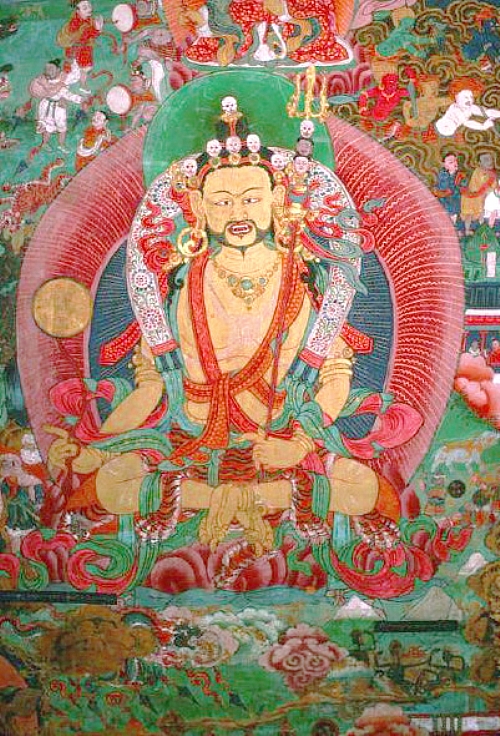
Cette exposition réunit pour la première fois une centaine d’œuvres bouddhiques prêtées par divers temples et monastères du Bhoutan, royaume himalayen situé entre le Tibet et l’état indien de l’Assam, et qui constitue une enclave miraculeusement préservée et vivante du bouddhisme tibétain. Objets de culte, ces pièces n’avaient jamais pour la plupart été présentées en dehors du Bhoutan. Composée d’une majorité de thangkas, peints ou brodés, parfois de très grandes dimensions, mais aussi de sculptures métalliques et de quelques objets liturgiques, s’échelonnant du VIIIème au XIXème siècle, l’exposition permettra d’évoquer les traditions artistiques bhoutanaises et ses développements historiques, encore mal connus, à travers divers thèmes iconographiques du bouddhisme tantrique. Il s’agira d’illustrer aussi la diffusion de celui-ci au Bhoutan par l’intermédiaire de grands maîtres indiens et tibétains ainsi que les principales figures religieuses qui jalonnèrent l’histoire du pays. Une série de films exceptionnels et inédits, tournés dans le pays, consacrés aux danses bouddhiques rituelles ou cham, accomplies par les moines lors de certaines grandes fêtes, complètera l’exposition. En outre, deux moines bhoutanais qui accompagneront celle-ci, exécuteront des rituels journaliers, dans un espace aménagé pour l’occasion au sein du musée, et qui sera accessible au public.
L’exposition est aussi une manière de célébrer le centenaire du règne de la dynastie Wangchuck et l’adoption par le Bhoutan, en 2008, de sa première constitution.

Catalogue de l'exposition:
 Au pays du Dragon : arts sacrés du Bhoutan, catalogue de l’exposition Editions RMN/ Musée Guimet – pages- prix : 50 euros- 392 pages. Avec un DVD offert de danses rituelles (cham).