Bienvenue / Welcome to Nelumbo - Le Journal !

Ce blog met à votre disposition des informations sur l'univers culturel et sur le monde de la recherche et de la science. Vous trouverez ici des annonces à propos de séminaires ou de conférences à venir, sur la recherche en sciences sociales (plus particulièrement en Asie du Sud-est), sur des évènements scientifiques et culturels, propositions d'emploi, des appels à contribution, etc.
Pour recevoir les actualités de Nelumbo, devenez membres ou souscrivez au RSS.
Contactez-moi pour toute requête, proposition de publication d'un article, suggestion d'un évènement, ou autre commentaire. Bonne visite !
---
This blog's purpose is to inform you about the cultural studies, research and science world. Nelumbo is generally focused on issues related to archaeology, history, and culture in Southeast Asia. It's also a place for posts and ads about seminars or conferences, on research in social sciences (particularly in South-East Asia), on scientific and cultural events, publications, calls for papers, jop posts, etc.
Feel free to use the search box above, subscribe for RSS, or become member.
Contact me for any request, recommend an article or submit contribution, suggest event, or something else. Corrections, comments and questions are most welcome. Have a good time !
Affichage des articles dont le libellé est Laos. Afficher tous les articles

11 nov. 2010

[Publication] Irasec-Observatory / Occasional Paper n°03.

Informal and illegal movement in the upper greater mekong subregion
Costs and benefits of informal networks for goods and people

by Lynn Thiesmeyer

Irasec-Observatory, Occasional Paper 03, November 2010, 144 pages.
ISBN: 978-616-90282-8-4
Downloadable for Free.

Cross-border migration and trafficking are, once again, the focus of intense scrutiny in Southeast Asia. There is a very rapidly increasing number and frequency of informally and illegally migrating persons and the goods they transport and consume. The area of the present research, undertaken during 2009, is currently known as the Quadrangle (Quadripartite) Economic Cooperation Zone, or the Golden Quadrangle. It has been targeted as a special economic cooperation zone, comprising Yunnan Province of China, Luang Nam Tha Province of Northern Laos, Shan State of Northern Myanmar, and Chiang Rai Province of Northern Thailand. The scope of this localisation of small-scale manufacturing and production, and of its logistics—cross-border informal and illegal transport—is vast. The goods surveyed in this research were agriculture products, including herbicides, fertilisers, and pesticides whose contents were unknown or clearly toxic beyond the regionally-agreed standard; there is special reference to illegal logging and timber trafficking from the same regions.  The research team consisted of five individuals: the present author, an environmental chemist from Japan, one environmental chemist from Taiwan, a social scientist from Taiwan, and an economist from Myanmar.
-

21 sept. 2010

[Article] India to renovate 11th century Shiva Temple in Laos.

Friday 10th September, 2010 | Laos News.Net (ANI)
India has agreed to renovate the Vat Phou or Wat Phou temple complex in southern Laos as part of deepening cultural and historical ties which have existed between the two countries for more than 2000 years.
Wat Phou is a ruined Khmer temple complex in southern Laos. It is located at the base of Mount Phu Kao near the Mekong river in Champasak province. There was a temple on the site as early as the sixth century. The summit of Phu Kao is like Linga, the phallic symbol of Shiva, thus giving it the more popular name, Lingaparvat.
"It is an ongoing restoration project which started in 2009. The work restarts again after the end of rainy season in Lao. It will take seven years for completion of the project. It will also help us to understand common cultural heritage of Lao," Secretary (East) in the Ministry of External Affairs, Vijaya Latha Reddy.
(Image : by magical-world on Flickr. Some rights reserved.)
[Read the full article here]

13 juin 2010

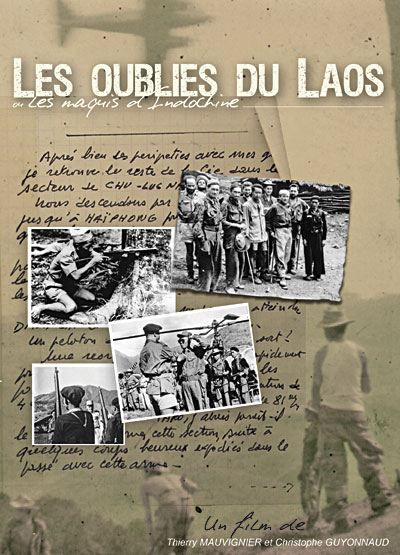
[Documentaire] Les oubliés du Laos.

Un film de Christophe Guyonnaud et Thierry Mauvinier
2008, 50 mn
Prix TTC : 18,50 €
Trélys Productions

Il s'agit d'un document exceptionnel qui est constitué principalement d'archives inédites, notamment des extraits de film amateur tourné par des officiers français des services spéciaux (restés jusqu'ici confidentiels) sur les maquis et maquisards hmong, thaï, niang, nung, man, akha... qui combattaient avec eux à partir de 1945, d'abord contre les Japonais puis contre les troupes viêt-minh, dans le cadre du GCMA (Groupement de commandos mixtes aéroportés) au Laos et au Vietnam. Le film est ponctué d'interviews de quelques officiers français dont le fameux Jean Sassi, d'explications données par un historien spécialiste du sujet, Michel David, et des principaux responsables parmi ces groupes ethniques qui, abandonnés par la France après les accords de Genève, en 1954, ont vécu une longue tragédie. Cette partie non glorieuse de l'histoire de la France en Indochine comme de la libération nationale vietnamienne, a été presque totalement occultée par les spécialistes. Ce film très dérangeant, au ton digne, retenu, réalisé par deux enquêteurs nés bien après les faits, au regard critique, représente la première tentative de réparer un oubli odieux, en osant simplement rappeler des faits authentiques.

Sur Youtube & Dailymotion

15 avr. 2010

[Média] Documentaire Révérences aux Bouddhas lao | 2

France 2 - dimanche 18 avril 2010 - 8h30
Sagesses bouddhistes poursuit son voyage au Laos en longeant le Mékong, afin d'atteindre quelques petits villages où la foi religieuse est intimement liée à la vie de chaque villageois, tant dans le quotidien que lors de fêtes raditionnelles. La dévotion pour le Bouddha est bien réelle et c'est toujours avec beaucoup de joie que des offrandes sont faites lors des visites des grottes sacrées le long du fleuve. Elles contiennent des centaines de statues de bouddhas, offertes ainsi dans l'anonymat et la simplicité, au fil du temps, pour le bonheur de tous.

8 avr. 2010

[Média] Sagesses bouddhistes - Révérences aux Bouddhas Lao.

A l'occasion du nouvel an traditionnel laotien, Sagesses Bouddhistes rend hommage au Laos et nous invite aujourd'hui à Luang Prabang la «ville lumière» et ville phare du bouddhisme theravada lao. Nous découvrons les bouddhas lao appelés également «bouddhas de pluie», d'une infinie beauté, grâce et douceur, à l'image du peuple lao lui-même qui surprend par sa sérénité, sa gentillesse et sa profonde foi et dévotion.
 08:30 
 Dimanche 11 avril 
France 2
Durée : 14 min
Réalisateur : Peter LIVERMORE
SevenOrients (Film - Musique - Editions - Design) - 76 avenue de Saint-Mandé, 75012 Paris - 7orients@7orients.com

4 mars 2010

[Internet] Exposition virtuelle : Auguste Pavie

 
Exposition virtuelle consacrée à Auguste Pavie et organisée par les ANOM (Aix-en-Provence).
"Auguste Pavie, l'explorateur aux pieds nus, Cambodge-Laos 1847-1925"

...
Notez que le site des Anom-Archives nationales d'outre-mer (installées à Aix-en-Provence depuis 1966) met régulièrement à notre disposition de nombreuses expositions virtuelles sur son site.


En ce moment :
- Auguste Pavie;
- Dreyfus (Célébrations nationales).

Vous pouvez accéder à toutes ces expositions en cliquant sur ce lien.

18 févr. 2010

Publication électronique : IRASEC - OBSERVATOIRE.

Du Triangle d’or au Quadrangle économique
Acteurs, enjeux et défis des flux illicites transfrontaliers dans le Nord-Laos

 
Danielle TAN, Doctorante Sciences Po/CERI

Téléchargement gratuit à partir des sites www.irasec.com/... & www.mekongantitrafic.com 

Discussion Paper n° 6 - Note de recherche n° 6, Fév.2010, 34p.

Cet article a pour objectif de présenter les principaux acteurs des flux illicites transfrontaliers qui traversent le Nord-Laos et d’analyser les enjeux et les défis que cette question complexe soulève.
L’auteur fait l’hypothèse que la généralisation macroéconomique des phénomènes de l’illicite et du développement délictueux s’affirme comme une mutation économique majeure qui s’explique dans une large mesure par la multiplication des opportunités qu’ont entraînée la libéralisation financière et la mondialisation de l’économie. L’économie illicite en Asie du Sud-Est constitue ainsi un trait majeur de l’économie politique de la région dont les origines prennent racines dans la colonisation. Aujourd’hui, ces activités souterraines constituent une marge de manœuvre certaine pour les États en développement comme le Laos ; elles permettent de contrebalancer les effets négatifs de l’ouverture des frontières et de la libéralisation économique, ce qui explique l’attitude ambivalente de l’État vis-à-vis de la régulation de ces flux.
Nourrie par une série d’enquêtes de terrain réalisées entre 2007 et 2009 dans les trois provinces du Nord-Laos concernées par le Corridor nord-sud (Oudomxay, Luang Namtha et Bokéo) et dans la capitale Vientiane, cette analyse tente dans un premier temps de comprendre la fabrique de l’illicite dans cette région en mettant l’accent sur les acteurs qui l’ont fait vivre et évoluer. L’auteur se concentre dans une seconde partie sur les enjeux qui se cachent derrière la question des flux illicites transfrontaliers, notamment la survie et le redéploiement de l’État postcommuniste à l’heure de la globalisation néolibérale. Puis les défis sociaux et environnementaux à relever seront examinés.

L’auteur :
Danielle Tan est doctorante en science politique au Céri/Sciences Po. Sa thèse porte sur l’analyse des réseaux chinois dans le Nord Laos et les recompositions sociales et territoriales que ces nouvelles mobilités génèrent. Cette recherche s’intègre dans le cadre du programme Transiter « Dynamiques transnationales et recompositions territoriales, approche comparative Amérique centrale et Asie du Sud-Est » financé par l’ANR.

IRASEC / Observatoire :
L’Institut de recherche sur l’Asie du Sud-Est contemporaine (IRASEC, USR 3142 – UMIFRE 22 CNRS MAEE) s’intéresse depuis 2001 aux évolutions politiques, sociales et environnementales en cours dans les onze pays de la région. Basé à Bangkok, l’Institut fait appel à des chercheurs de tous horizons disciplinaires et académiques qu’il associe au gré des problématiques. Il privilégie autant que possible les démarches transversales.
L’observatoire des trafics est en charge depuis septembre 2008 de l’analyse des mouvements illicites transfrontaliers en Asie du Sud-est continentale. Il soutient des programmes de recherche afin de proposer une meilleure connaissance des mécanismes des trafics illicites et des systèmes de lutte antitrafic à différentes échelles dans la région. L’observatoire est accueilli au sein de l’IRASEC et est financé par le ministère français des affaires étrangères et européennes (DGM/ECODEV/MGD) dans le cadre du projet « Lutte contre la contrefaçon dangereuse pour la santé et la sécurité dans la sous-région du Mékong ».

Contacts :
Benoît de Tréglodé, directeur de l’Irasec
Anne-Lise Sauterey, coordinatrice de l’Observatoire
IRASEC – Observatoire -  29, Sathorn Tai Road , Bangkok 10120, Thailande - Tel : (66) 026 27 21 87
www.irasec.com
www.mekongantitrafic.com

3 févr. 2010

Iron Age discovery uncovers prehistoric burial customs in Laos [The Earth Time / MMAP]


Vientiane, Laos - The discovery of Iron Age human bone fragments in Laos has shed new light on the region's prehistoric burial customs, state media reports said Friday. A team of Lao and foreign archeologists foundthe fragments last week in a burial ground believed to be about 2,000 years old when South-East Asia was in the Iron Age, the Vientiane Times reported.
The discovery was made during a dig known as the Middle Mekong Archaeological Project, which is a joint effort between Laos' Department of Heritage and the University of Pennsylvania Museum in the United States.
"Last week, we unexpectedly found two skulls and a fragment of a third, a baby, along with some body bones," said Joyce White, associate curator at the University of Pennsylvania Museum. "It is quite a significant discovery of Lao archaeology."
Also among the items found was a burial pot containing human bones, which was the first such example of a secondary burial, or the custom of dismembering a corpse and removing all flesh so the bones could be placed in a container.
Although the practice was common in neighbouring Thailand and Vietnam, this was the first evidence of a secondary burial in what is now Laos.
The project is funded by the Henry Luce Foundation.
22 jan 2010 - Copyright DPA

On Middle Mekong Archaeological Project's blog : see the article.

20 janv. 2010

Publication du premier volume du Journal of Lao Studies.


The Center for Lao Studies is pleased to announce the inaugural issue of the Journal of Lao Studies (JLS), Volume 1, Issue 1.  JLS is managed by a volunteer, multidisciplinary editorial board representing a number of academic institutions from around the world.
Please visit www.laostudies.org/journal to see the complete journal.

The table of contents is below:

Articles
    - Land, Rubber and People: Rapid Agrarian Changes and Responses in Southern Laos Abstract. Ian G. Baird. pp 1-47
    - Language and Culture in Laos: An Agenda for Research Abstract. Nick J. Enfield. pp 48-54
    - The Countries of Birth and Ethnicities of Australia's Hmong and Lao Communities: An Analysis of Recent Australian Census Data Abstract. James E. Coughlan. pp 55-85

Interviews
    - Interview with James Chamberlain conducted by Grant Evans. Grant Evans. pp 86-104

Reviews
    - Yves Goudineau and Michel Lorrillard, eds: Recherches nouvelles sur le Laos/New Research on Laos. Études thématiques 18. Vientiane, Paris: École Française d'Extrême-Orient, 2008. pp. 678., Martin Stuart-Fox. pp 105-118
    - Spirits of the Place: Buddhism and Lao Religious Culture by JOHN CLIFFORD HOLT. Honolulu: University of Hawai'i Press, 2009. pp. 329+xiii., Justin McDaniel. pp 119-123
    - Globalization, Culture and Society in Laos by BOIKE REHBEIN. London & New York: Routledge, 2007. pp. 171., Oliver Tappe. pp 124-126

7 janv. 2010

MMAP - Middle Mekong Archaeological Project - Ouverture d'un blog


Le MMAP est un programme de recherche qui s'intéresse aux occupations humaines préhistoriques dans la vallée du Mékong (12,000 BC à aujourd'hui).
Amy Ellsworth, Digital media developer à l'University of Penn Museum, accompagne l'équipe du MMAP pour la saison 2010 à Luang Prabang pour rendre compte du projet grâce à des articles qu'elle publie sur son blog et grâce à des vidéos

Pour plus d'informations sur le MMAP :


Depuis 2001, ce projet est co-dirigé par le Dr Joyce C. White (Musée de Luang Prabang) avec la collaboration du Musée d'Archéologie et d'Anthropologie de Pennsylvanie et le Département des Musées et de l'Archéologie du Laos.

Chercheurs :
- Joyce White, Penn Museum
- Bounheuang Bouasisengpaseuth, Vientiane National Museum, Laos
- Katherine Arrell, Leeds University, UK
- Huw Barton, University of Leicester, UK
- Korokot Boonlop, Sirindhorn Anthropology Centre, Bangkok
- Sureeratana Bubpha,  Thammasat University, Bangkok
- Elizabeth Hamilton, Penn Museum
- Helen Lewis, University College Dublin, Ireland
- Benjamin Marwick, University of Washington, Seattle
- Gillian Thompson, University of Bradford, UK

Voir aussi d'autres informations sur les sites :

3 déc. 2009

Bangkok Post - Treasures of the deep gain protection

Divers taught to preserve secrets in old shipwrecks

About 18 metres below the sea off Rayong province, 15 divers from seven countries are exploring a wooden shipwreck.
The exploration is part of Unesco's six-week training on underwater cultural heritage preservation.
The divers are from Cambodia, Indonesia, Laos, Malaysia, the Philippines, Sri Lanka and Thailand.
They have been picked for an underwater heritage protection programme organised by the United Nations Education, Scientific, and Cultural Organisation (Unesco) and the Fine Arts Department's Underwater Archaeology Division (UAD) which runs from Oct 26 to Dec 6.


A participant in the six-week training on underwater cultural heritage preservation shows a piece of ancient artifact found at an underwater archaeological site in Rayong.
PHOTOCOURTESY OF UNESCO.


Division head Erbprem Vatcharangkul said Thailand has 64 underwater archaeological sites. He said all of them, especially those in shallow water, were under threat from treasure hunters.
Protection of the sites required well-trained staff and cooperation from local people, including fishermen.
Other countries in the Asia-Pacific region face similar problems which prompted Unesco to set up the regional field training centre to promote underwater heritage protection in the region and to exchange conservation information.
The centre plans to hold four training courses. The course in Rayong was the first.
Trainees will be taught by experts from Australia, the Netherlands and Thailand.
"The participants will be trained in underwater archaeology protection from basic to advanced levels, both in theory and practice," Mr Erbprem said.

On the 15th day of the course, the trainees were assigned to dive to a depth of 18 metres to measure the length, width and height of a wooden shipwreck which was found two nautical miles west of Koh Mannok, off Rayong's Klaeng district.
"The boat structure and some ancient coins which were found at the site could [reveal] the age of the sunken boat which belonged to the early period of King Rama VI [early last century]," he said.
"This shipwreck is another piece of the jigsaw that will help give a clear picture of history."

The official called on fishermen to help safeguard the archaeological site by stopping their use of destructive fishing practices in the area.
He said the government should also ratify the 2001 Convention on the Protection of Underwater Cultural Heritage for better protection of the country's underwater heritage from commercial exploitation.

Nudy Phann, 38, deputy director-general of the General Department of Cultural Heritage, Ministry of Culture and Fine Arts in Cambodia, who took part in the training, said he believed his country had several underwater archaeological sites, but only one shipwreck had been discovered so far.
"No one has yet studied the shipwreck," he said. "We don't have expertise, equipment, or sufficient knowledge to explore underwater cultural heritage - that is why I am here to attend the training.
"Underwater cultural heritage is new for my country even though we ratified the convention in 2007.
"I am happy to be here and when I go back to my country I plan to set up a team to start surveying shipwrecks."

Thai trainee Duangpond Kanya Singhasanee, 29, a graduate student from Silpakorn University's historical archaeology faculty, said the training was extraordinary because participants were allowed to visit sites which were normally hard to reach.
Ms Duangpond is a diving master and had visited several archaeological sites.
"This training has inspired me to work in the field of underwater archaeology," she said.


23/11/2009 | Lamphai Intathep

27 nov. 2009

Site Internet : "Viêt-Nam, Laos Cambodge - Sources et aides à la recherche"


Ce site, géré par des membres de l'Institut d'Asie Orientale (unité de recherche mixte (UMR5062) associée au CNRS (Centre national de la recherche Scientifique). Il est abrité dans les locaux de l’Ecole Normale Supérieure Lettres et Sciences Humaines à Lyon), et plus particulièrement par Christopher E. Goscha, François Guillemot,met à disposition des étudiants et des chercheurs en sciences sociales sur le Vietnam, le Laos et le Cambodge un instrument confortable et pour accéder aux informations électroniques essentielles sur cette région. Le site donne des moyens de conduire une recherche documentaire fournie et de valoriser les études sur le Vietnam, le Laos et le Cambodge.

Le site regroupe six onglets offrant toutes les indications utiles sur les fonds d'archives, les fonds documentaires et les centres de recherche disponibles en France sur ces trois pays de la péninsule.
  • « Archives » : présente une cinquantaine d'adresses électroniques sur les fonds d'archives relatifs à ces pays en France et à l'étranger ;
  • « Bibliothèques » : renvoie aux bibliothèques françaises comprenant des ouvrages sur l'Indochine ;
  • « Centres de recherche » : à travers les centres de recherche proposés, permet d'avoir un regard relativement complet de la recherche française sur le Viêt-Nam, le Laos et le Cambodge ;
  • « Liens » : cet onglet renferme des sous-parties (recherches, enseignement, connaissances) extrêmement riches permettant d'accéder à des sources documentaires en ligne principalement en Europe et aux Etats-Unis ;
  • « Logement » : présente les possibilités de logement pour les chercheurs désirant se rendre au CAOM à Aix-en-Provence, au SHAT à Vincennes ou à des fonds documentaires sur Paris ;
  • « Publications » : présente une liste non exhaustive qui renvoie aux principales publications françaises et mémoires ou thèses soutenus de ces cinq dernières années.

Vous trouverez entre autres : 

Liens : Asie - Outils de travail, ressources générales

Je vous invite donc à visiter ce site très utile.