Bienvenue / Welcome to Nelumbo - Le Journal !

Ce blog met à votre disposition des informations sur l'univers culturel et sur le monde de la recherche et de la science. Vous trouverez ici des annonces à propos de séminaires ou de conférences à venir, sur la recherche en sciences sociales (plus particulièrement en Asie du Sud-est), sur des évènements scientifiques et culturels, propositions d'emploi, des appels à contribution, etc.
Pour recevoir les actualités de Nelumbo, devenez membres ou souscrivez au RSS.
Contactez-moi pour toute requête, proposition de publication d'un article, suggestion d'un évènement, ou autre commentaire. Bonne visite !
---
This blog's purpose is to inform you about the cultural studies, research and science world. Nelumbo is generally focused on issues related to archaeology, history, and culture in Southeast Asia. It's also a place for posts and ads about seminars or conferences, on research in social sciences (particularly in South-East Asia), on scientific and cultural events, publications, calls for papers, jop posts, etc.
Feel free to use the search box above, subscribe for RSS, or become member.
Contact me for any request, recommend an article or submit contribution, suggest event, or something else. Corrections, comments and questions are most welcome. Have a good time !
Affichage des articles dont le libellé est fouilles. Afficher tous les articles

18 janv. 2011

[Article] Digging up South-east Asia's oldest ruins.

Govt hopes to get World Heritage listing for Kedah site that's 1,900 years old
Jan 7, 2011  | The Straits Times | By Carolyn Hong, Malaysia Bureau Chief
Students excavating the structures discovered in Bujang Valley. Two years ago, a team from Universiti Sains Malaysia and government departments uncovered man-made structures dating back 1,900 years. -- PHOTO: MOKHTAR SAIDIN
KUALA LUMPUR | Two years ago, Malaysian archaeologists working in the coastal plains of south Kedah struck an amazing find when they uncovered man-made structures that turned out to be the oldest in South-east Asia.
The team of 30 from Universiti Sains Malaysia (USM) and various government departments found iron ore smelters complete with furnaces and iron slag that dated back 1,900 years to AD110.
They also dug up a brick structure believed to have been used for ritual purposes and a roofed brick platform jetty near Sungai Batu - both dating from the early part of the second century AD.
USM archaeologist, Associate Professor Mokhtar Saidin, realised then that they had found remnants of the old civilisation referred to in many historical texts.
'It's the most complete evidence of a civilisation - the port, industries and rituals, and they were the oldest monuments in South-east Asia,' he told The Straits Times this week.
The discoveries brought visitors flocking to the site located about 90km from Kedah's capital Alor Star. It is part of the Bujang Valley archaeological site where ancient temple ruins have been excavated since the 1840s.
'We have put on a small exhibition as people keep arriving by the busload. We recently had a group of Singapore museum volunteers visit us too,' said Dr Mokhtar.
The tourism aspect has aroused the interest of the federal government, with Information, Communications and Culture Minister Rais Yatim recently saying it hopes to get the site on the Unesco World Heritage List.
[ ... Read the full article here ... ]

21 nov. 2010

[Article] 3,000-year-old stone instrument found in Binh Thuan.

November, 18 2010 | Viêt Nam News

HA NOI – Five-stones of a musical instrument believed to date back 3,000 years has been found in central Binh Thuan Province.
Farmer Ho Giap of the province's Duc Linh District found the pieces while working his field.
Binh Thuan Museum director Nguyen Xuan Ly said the trapezium-shaped instrument was created from the dark green stone. Based on its shape and the materials, it could be three millenniums old.
One of the graduated five pieces of the instrument, which has been given to the museum for further study, is broken.
A similar stone instrument was found earlier in the same location.

Read this article here

19 nov. 2010

[Article] More evidence of Oc Eo culture found in Ben Tre.

11/17/2010 | VNA via VOV News

Recent archaeological studies have revealed more evidence of the existence of the Oc Eo culture dating back to 2,000-2,500 years ago in the Mekong Delta province of Ben Tre.
First traces of the ancient culture were discovered by French archaeologist Louis Malleret, who gave it the name of Oc Eo. The Oc Eo culture is believed to have formed and developed in the southern delta, largely in An Giang, from the first to the sixth century AD.
In the mid-1990s, a farmer named Huynh Van Be in Binh Thanh village, Binh Phu commune found several stone graters and axes in his garden. In 2003, a working team from the Vietnam Institute of Archaeology (VIA) and the Ben Tre Museum conducted an excavation in the area and discovered more stone tools and over 13,000 pieces of ceramics of all types.
After three excavations and two exploration digs on a total area of 484.5 sq.m, the experts collected nearly 500,000 artefacts, with 99 percent being ceramics, and over 250 kilogrammes of animal and human bones as well as Linga and Yoni objects.
The excavations also revealed vestiges of an ancient village, which scientists named Giong Noi, including a ceremic-burning ground, several large kitchens and big houses. The experts believe that Giong Noi people had their own religious beliefs which might have links with the Brahmanism as seen in the worshipping of stone, tortoise, and the sacred objects of Linga and Yoni.
[ ... Read the full article here ... ]

21 oct. 2010

[Article] Archaeologists to resume Srikshetra dig.

October 4 - 10, 2010 | The MyanmarTimes | By Cherry Thein

A TEAM
of officials and students from the state-run Field School of Archaeology (Pyay) will resume seasonal excavations early this month of the palace complex in the ancient Pyu city of Srikshetra in northern Bago Region.
The principal of the school, U Thein Lwin, said the aim of the dig will be to “uncover the centre of the palace grounds”.
“Based on archaeological and historical evidence, we hope to be able to determine the chronology of events at the palace, the stratigraphy of the site and the history of the structure,” he said.
Srikshetra – located in Hmaw Zar village, about 8 kilometres (5 miles) southeast of present-day Pyay – flourished as a major Pyu settlement from the fourth to ninth centuries AD, pre-dating the rise of Bagan in the 11th century.
U Thein Lwin said the excavation will provide practical experience for diploma students currently enrolled at the field school.
“The exploration work will take place in the post-monsoon season and will last for about four months,” he said. “Anything we uncover will be taken to the Srikshetra Museum for study and classification before it’s moved to the National Museum in Yangon.”
U Thein Lwin said the Ministry of Culture, which runs the field school, granted permission in 2008 for long-dormant excavations to resume at Srikshetra, with the goal of learning more about the culture, civilisation and customs of the Pyu people, as well as about the architecture of the ancient city.
He added that the ministry, which is dedicated to preserving and safeguarding Myanmar’s cultural heritage, provides a grant of US$5000 for each excavation project.
“Myanmar has about 12 archaeological and historical sites that should be maintained as the country’s national heritage, but we need to determine the best way to protect these sites and we need to educate young people to cherish their heritage,” he said.
Archaeological excavation of Srikshetra dates back to 1907, when stone inscription scholar U Taw Sein Kho and Frenchman Leon Debeylie began exploring the area. Occasional digs continued during the following years until they were disrupted by World War II.
Archaeologist U Sein Maung Oo resumed work at the ancient city in 1962-1963. In 1968, archaeologist U Than Swe uncovered sections of the palace wall and housing complex, before exploration of the area again ground to a halt.
The Ministry of Culture granted permission to restart work in 2008, resulting in an excavation project during the 2008-2009 winter season that unearthed a prominent section of the city wall.
U Thein Lwin said that in an effort to catalogue the work being done at Srikshetra, archaeologists have numbered the areas where excavations have taken place over the years, naming 43 sites, or mounds, through to the end of 2009.
Last year, an excavation team picked up work where U Than Swe had dug in 1968, naming the sites the number 44 and 45 mounds. It was here that the palace grounds were located and where excavations will resume this month.
Excavations at Mound 37 (above) and Mound 44 (middle) in the ancient Pyu city of Sriskshetra, near modern-day Pyay. Below : Artifacts dug up at Mound 37. Pics: Supplied
[...Read the full article here ... ]
-

19 oct. 2010

[Article] Prehistoric Remains Found in Aceh Town.

September 27, 2010 | Jakarta Globe | Antara

Takengon, Aceh. Two archeologists from Medan have found evidence that a village in Central Aceh district had been inhabited by prehistoric humans.
Ketut Wiradnyana and Lucas Partanda Koestoro announced on Sunday that they had found artifacts such as a a square stone axe, a niche, pottery pieces and a human skeleton inside a cave near Danau Laut Tawar, a lake in Kampung Mendale.
“One of our latest discoveries is a human skeleton which we found in the Ujung Karang Kebayakan area, another excavation site near Kampung Mendale,” Ketut said.
The skeleton’s exact age has yet to be confirmed, since the excavation is still ongoing.
Ketut said the artifacts would have to undergo a carbon dating test at the National Atomic Energy Agency (Batan).
Last May, residents of Jayapura district in Papua Province found prehistoric relics at two different locations.

[...Read the full article here...]

8 juil. 2010

[Article] Ancient ship replica helps fund Java dig.

4 July 2010 | The Japan Times

NAHA, Okinawa Pref. (Kyodo) The Indonesian government and a Japanese academic group have recently reconstructed an ancient ship to raise money for an archaeological study on historic ruins in and around Java.


Glimpse of the past: A replica of an ancient Indonesian ship leaves Madura Island, Java Province, on June 27 for a six-month, 9,000-km journey. JAPAN MAJAPAHIT ASSOCIATION/KYODO PHOTO

According to the Japan Majapahit Association, the ship has been making port calls in Asian countries since late last month, asking for financial and technical support to excavate the ruins of the Majapahit kingdom, which existed in the area from the 13th to the 16th century.
The ship was built in Madura, part of Indonesia's Java Province, and left there on June 27 for a six-month, 9,000-km journey, before heading back to Jakarta.
It will reach Japan around the middle of July, making its first stop in Kudaka Island, Okinawa Prefecture. The island served as a trading post of the Ryukyu kingdom, which used to govern Okinawa.
The ship will then sail to Naha. The crew will pay Okinawa Gov. Hirokazu Nakaima a courtesy call before continuing on their journey to Kagoshima, Yokohama, Tokyo and Fukuoka.
The 20-meter ship was reconstructed based on an ancient painting that was on a relief in Java's Borobudur ruins dating back to the eighth century. It is made entirely of wood using materials such as teak and bamboo, and does not use a single nail, according to the group.
The majority of the 15-person crew is Indonesian. Yoshiyuki Yamamoto, a Japanese explorer who canoed across the Indian Ocean, is on board as a project leader.

More informations :
- ‘Majapahit spirit’ to sail to eight countries | The Jakarta Post, Jakarta | 06/28/2010

21 juin 2010

[Articles] Founds in Lao Cao cave

June, 17 2010 | VietNamNews
Twelve animal species found in Lao Cai cave

LAO CAI — More than 500 animal fossils have been discovered in a cave in the northwestern province of Lao Cai, according to the Viet Nam Archaeology Institute.
Archaeologists were working for nearly a month at Ma Tuyen Cave, in Muong Khuong District.
The fossils are believed to belong to 12 animal species, including bear, rhino, elephant, porcupine, deer, pig, horse, dog, monkey and mouse, scientifically named Stegodon orientalis Owen, Elephas indicus, Palaeoloxodon naumanni, Ailuropoda mela-noleuca, Rhinoceros, Servus and Sus scrofa.
More than half of the items were discovered by chance by workers from a local construction firm while renovating the cave in 2009.
Chew on this: Fossil teeth of from Palaeoloxodon naumanni, found at the Ma Tuyen Cave in the northwestern province of Lao Cai. — File Photo
~~~~~~
Saturday ,Jun 12,2010 | SGGP english | By Truong Ngoc; Translated by Hai Mien
10,000 year old elephant teeth discovered in Lao Cai

Fossil teeth of straight-tusked elephants (Palaeoloxodon naumanni) that became extinct about 10,000 years ago, have been discovered in the northern province of Lao Cai.
That was one of preliminary estimation on fossil items excavated at Ma Tuyen Cave in Muong Khuong District. The estimation was organized by Lao Cai Province Museum, Department of Culture, Sports and Tourism and Hanoi-based Institute of Archaeology on June 11. 

[Article] Artefacts unearthed at Bayon temple.

Wednesday, 09 June 2010 15:01 | The Phnom Penh Post | Rann Reuy

Siem Reap Province - Archaeologists from Cambodia and Japan have recovered an assortment of nearly 1,000 items.
CAMBODIAN and Japanese archaeologists have since January unearthed about 1,000 artefacts buried beneath Bayon temple in Angkor Thom, according to a report released Tuesday during a conference concerning conservation efforts in the Angkor Wat temple complex.
The findings include pieces of gold, hardware, tools and religious relics, according to the report, released as part of the 19th Technical Committee meeting of the International Coordinating Committee for the Safeguarding and Development of the Historic Site of Angkor, which concludes today.
Kou Vet, chief of the archaeological unit for Japan-Apsara Safeguarding Angkor, said in a statement that his team had also discovered ceramics thought to have been imported from Thailand, Vietnam and Japan. [...]


Archaeologists point to images detailing artefacts discovered at Bayon temple on Monday, the first day of a twice-yearly conservation meeting in Siem Reap.
[
Photo by: Rann Reuy]

1 juin 2010

[Article] Hundreds of jar tombs unearthed in Phu Yen.

24-05-2010 | VietNamNet Bridge | Duong Thanh Xuan
--
Hundreds of “jar tombs” (urns) have been discovered in a ten hectare area along the banks of Ky Lo River in Phu Yen province.
The urns are of different sizes, ranging from 1.2 to over 2m long and 0.5-0.6m wide, and were found along the Ky Lo River in the two villages of Tan and Tan Phu in Xuan Son Nam commune.
At the archaeological site, hundreds of terra-cotta jar jars have been unearthed. They are oval, with two open tips like doors. Apart from broken pieces of the jar is debris from bowls, plates and white bricks, which are very thin but heavy.
Bui Van Tan, 62, a resident, noted that his village was formerly located on the relic site, but had been swept away by a horrible flood in 1924.
This area became a sugar cane and cassava field until it was ruined by the November 2009 flood, which exposed the urns.
Some residents collected fences and crowns from this site that they sold to antique traders.
Jar tombs belong to Sa Huynh Culture.

24 avr. 2010

[Article] Meet Sampson, the 2000-year-old Thailand dog wowing archeologists worldwide.

April 2010 | JCNN | By Cassie Cocks
--
Every dog has its day – even if it has to wait 2000 years for it! That’s how long it took to discover the bones of suspected wolfhound Sampson, whose remains were recently uncovered at a dig site in Ban Non Wat, north-east Thailand.
“The first thing we noticed about it was the size. It stood a bit less than a metre,” says Allison Isepy, who found Sampson’s bones together with fellow James Cook University student Belinda Duke. “It’s a very tall dog – probably a wolfhound.”
Isepy says she’s only briefly analysed Sampson’s bones but believes he died of natural causes and estimates his age to be about six. She’ll be returning to Thailand in the June semester break to continue her analysis and conduct a comparative study of other dog bones found on-site.
Each year students from James Cook University travel to Thailand to join the team working on the prehistoric site at Ban Non Wat. “It really is one of the most exciting excavation sites in the world,” Isepy says. “Every 10 centimetres we find something else!”
The Ban Non Wat project attracts archaeologists, geologists, anthropologists and biologists from many countries including Canada, England and the USA. The site contains layers from 4000 years ago and is focused on investigating the dynamic relationship between people and changes in the environment. It’s part of a 15-year series in the region and, for the last three years, has been directed by archaeologist Dr Nigel Chang and anatomy specialist Dr Kate Domett, both from James Cook University.
“This site gives our students a chance to be part of an international project and to gain new experience and skills,” Dr Chang says. “The project is generating a life of its own. It has inspired local universities and provided more opportunities for the community.”
Students visit Ban Non Wat for two or three months each year, so it’s up to local scientists and volunteers to learn the required skills to keep the project going. “The project promotes JCU, archaeology and education, as community learning develops on-site,” Dr Chang says. “And the exciting thing about Sampson is it’s the best-preserved dog burial we’ve found so far.”
The Ban Non Wat project is made possible through funding from the Earthwatch Institute and the many volunteers who take part in the dig.
--
More informations :
- Bronze Age Dog Burial at Ban Non Wat | April 19, 2010 | alisonincambodia
--

8 avr. 2010

[Article] Dig site to open study centre.

Ban Chiang village in Udon Thani to showcase pottery tradition, prehistoric past.
March 27, 2010 | Bangkok Post | Writer: Naowarat Suksamran.

Ban Chiang, a popular archaeological site in Udon Thani, will soon become a research and study centre where tourists and members of the public can learn more about the prehistoric settlement.
The planned development of Ban Chiang in Udon Thani's Nong Han district, listed as World Heritage Site No. 359, follows advice given by Her Royal Highness Princess Maha Chakri Sirindhorn during her visit to the site early last month.
The Princess was interested in archaeological studies and wanted to see the conservation of national treasures.
Fine Arts Department director-general Kriangkrai Sampatchalit put his deputy, Sahawat Naenna, in charge of the project to develop Ban Chiang as a study centre.
Ban Chiang village dates back to the Bronze Age and is built on the site of an ancient cemetery. The earliest grave dates from about 2100 BC.
Mr Sahawat said he had consulted archaeological experts, historians and academics about the establishment of the centre at Ban Chiang.
If the project proves successful, it would be expanded to other archaeological sites nationwide, he said.
Once it is developed as a research and study centre, Ban Chiang will attract visitors interested in items excavated at the site, including ancient artefacts, human skeletons, and historic pottery. The site would also serve as a learning centre for those interested in the patterns of painted earthenware in prehistoric cultures, and painting techniques used on pottery and other utensils that showcase ancient technology, said Mr Sahawat. [...]


Her Royal Highness Princess Maha Chakri Sirindhorn looks at ancient objects displayed at the Galyani Vadhana Building at the Ban Chiang National Museum in Udon Thani on Feb 9 after presiding over the opening of the building.
Photo Courtesy of Udon Thani Public relations Office.

Read the full article here.

10 mars 2010

[Article] New archaeological sites reveal life after ancient Toba eruption.

Tuesday February 23, 2010 | The Star

LONDON: Newly discovered archaeological sites in southern and northern India have revealed how people lived before and after the colossal Toba volcanic eruption 74,000 years ago, according to Press Trust of India (PTI) on Tuesday.

The international and multidisciplinary research team, led by Oxford University in collaboration with Indian institutions, has uncovered what it calls 'Pompeii-like excavations' beneath the Toba ash.
The seven-year project examines the environment that humans lived in, their stone tools, as well as the plants and animal bones of the time.
"This suggests that human populations were present in India prior to 74,000 years ago, or about 15,000 years earlier than expected based on some genetic clocks," said project director Michael Petraglia, Senior Research Fellow in the School of Archaeology at the University of Oxford.
The team has concluded that many forms of life survived the super-eruption, contrary to other research that has suggested significant animal extinctions and genetic bottlenecks.
According to the team, a potentially ground-breaking implication of the new work is that the species responsible for making the stone tools in India was Homo sapiens.
Stone tool analysis has revealed that the artefacts consist of cores and flakes, which are classified in India as Middle Palaeolithic and are similar to those made by modern humans in Africa.
"Though we are still searching for human fossils to definitively prove the case, we are encouraged by the technological similarities.
Toba is in the island of Sumatra in Indonesia and an area of widespread speculation about the Toba super-eruption is that it nearly drove humanity to extinction.
The fact that the Middle Palaeolithic tools of similar styles are found right before and after the Toba super-eruption, suggests that the people who survived the eruption were the same populations, using the same kinds of tools, says Petraglia.
The research agrees with evidence that other human ancestors, such as the Neanderthals in Europe and the small brained Hobbits in Southeastern Asia, continued to survive well after Toba.
Although some scholars have speculated that the Toba volcano led to severe and wholesale environmental destruction, the Oxford-led research in India suggests that a mosaic of ecological settings was present, and some areas experienced a relatively rapid recovery after the volcanic event.
The team has not discovered much bone in Toba ash sites, but in the Billasurgam cave complex in Kurnool, Andhra Pradesh, the researchers have found deposits which they believe range from at least 100,000 years ago to the present.
They contain a wealth of animal bones such as wild cattle, carnivores and monkeys.
They have also identified plant materials in the Toba ash sites and caves, yielding important information about the impact of the Toba super-eruption on the ecological settings. - Bernama (Read the article here).

More informations :
- Toba Volcano | by George Weber | original article (feb. 2006).
- Paleoanthropology in the 1990's - Population Bottlenecks and Volcanic Winter | Essays by James Q. Jacobs | 2000
- Volcan Toba | Activ (Association pour la connaissance et la transmission de l'information en Volcanologie).

8 mars 2010

[Article] Ancient objects found at former Hoa Lu capital.

02.23.2010 | VOVNews/VNA

A host of ancient objects dating back to the 10th -18th century have been discovered at the Hoa Lu ancient capital relic in the northern province of Ninh Binh.

The objects made in the Dinh (968-980), Ly (1009-1225), Tran (1225-1400) and Le (1418-1789) dynasties include square floor tiles with lotus and phoenix patterns, bowls, dishes, jars and other pottery items. They were found after archeologists had excavated an area of over 500 sq. metres at the relic site.
The archeologists said they will continue their excavation in the coming time to find the remains of the ancient capital.
The excavation project is jointly carried out by the Ninh Binh Department of Culture, Tourism and Sports and the Vietnam Museum of History.

(Read the article here)

2 mars 2010

[Article] Megalithic site found in South Sumatra

02/17/2010  |  The Archipelago

PALEMBANG, South Sumatra: A megalithic settlement has recently been unearthed at Skendal village, 10 kilometers from the town of Pagaralam in South Sumatra.
Irfan Wintarto, an official at the Lahat Culture and Tourism Agency's Historical and Archeological Preservation Department, said local residents had discovered around 36 types of rocks on a 150-by-300-meter plot in the middle of a 2-hectare coffee plantation. The site is currently being investigated by the Archeological Region Conservation and Heritage Center (BPPP).
"The findings are believed to date back to around 5,000 B.C.," Irfan said.
"The types of rocks and megaliths found are quite diverse."
Among the items are a mortar and a 1-by-1.3-meter relief showing a woman riding an elephant with two children, and people being attacked by crocodiles and large snakes, as well as several altars believed to have been used for offerings. - JP

15 janv. 2010

Ancient coins and artefacts found in Terengganu’s Chinatown worksite

The Star - Jan. 13, 2010 - By R.S.N. MURALI 
KUALA TERENGGANU: Earth-works for the new ring road and sewage system in Chinatown here have uncovered hundreds of ancient coins and other artefacts.
And there is concern that workers at the site and the public may have been quietly digging up these items to sell.
Site manager Omar Mahmod said many items might have been sold before he realised that his worksite contained buried treasures when he uncovered a porcelain vase that he believed was from ancient China.
He questioned his workers and discovered that many items had been found at the site.
“Many of these artefacts were found when we started earth excavation in February last year, but the workers concealed their find from us at first,” he said yesterday.
Realising that the items were being sold off on the quiet, he directed the workers to declare any artefacts found from the site.
He also directed his colleagues to comb the area to search and hand over the relics to museum authorities.
“Those who comb the area after a heavy downpour can be sure of finding such artefacts,” he said.
Since discovering the porcelain vase, Omar has dug out coins with early Jawi writing, Arabic script and ancient Chinese emblems, ancient Indian ornaments and Chinese jars, plates and vases.
An Indonesian worker from the site who requested anonymity said he surrendered most of the artefacts to his superior but admitted he had sold some to collectors.
“Such coins are collectors’ items some of which I will take back to Surabaya,” he said.
State MCA chief Toh Chin Yaw said the items were priceless and part of the state’s history. He said the contractor had been asked to declare any future discovery of artefacts. “We want to preserve valuable items extracted at the site for our future generations,” he said.
Toh said he had informed the relevant authorities to visit the site and claim any artefacts found.

Picture : Priceless relics: A foreign worker showing the coins that he extracted from the constuction site at the back of the Kuala Terengganu Chinatown.

15 nov. 2009

Annonce - Projet de fouilles: Philippines, Dr. Peter Lape & Dr. Victor Paz


Site Name : Palawan Island Archaeology Field School
Country : PHILIPPINES
Dates : 29 March - 2 May 2010
Site Type : Survey/Excavation


Project Details :
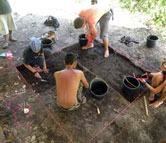
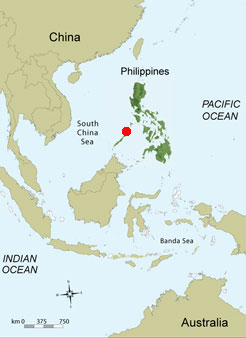
           We will meet in Manila on March 29, 2010 for several days of pre-excavation orientation at the University of the Philippines, Diliman. We will then travel to Palawan by plane, and from the airport to our sites in the El Nido and Sibaltan Bay area by van. The next four weeks will be spent surveying and excavating a variety of sites dating to the past 2000 years at coastal and small offshore island locales, with some visits to other famous Palawan sites (such as the Ille Cave complex).
Fieldwork will involve daily hiking and/or travel by small boats. We will return to Manila via plane by about April 30 to catch your flight home by May 2. Students may have options for post-field work lab analysis in Manila or Seattle for additional credit.
You will learn archaeological field skills by working in real field conditions as part of ongoing archaeological research, working with 15-20 students and staff from the USA, the Philippines and other SE Asian nations. Language of instruction will be English. Archaeological field work is physically demanding, especially in the tropical climate of Palawan. We will live in simple guest houses and/or tents with shared bathing facilities. Meals will feature delicious regional dishes prepared by local cooks. Free days can be spent exploring the local villages, mountains, coral reefs and beaches that draw thousands of tourists to beautiful Palawan Island each year.
          Tentative course fees are $4,400 ($4,600 for non-UW students) which include all tuition, food, housing and travel within the Philippines. Other costs not included in the course fee are travel to Manila (about $1300-1600 from the US), passport and visa fees, health insurance and personal cash. Financial aid may be available. A limited number of full fellowships (including travel costs) are available to students from Southeast Asian universities. Applicants must complete the application form by November 16, 2009, and complete an interview. No previous archaeology experience required. Successful applicants will be notified by December 14, 2009. Course deposit of $500 is due by January 15, 2010 and balance is due by March 27, 2010.

Project website : faculty.washington.edu/plape/palawan/ (opens in new window)
Director/ Project Organiser : Dr. Peter Lape and Dr. Victor Paz
Organisation or Institution : University of Washington
Email Contact : plape@u.washington.edu

Annonce - Projet de fouilles: Tambora, Indonésie, Dr. M. Géria.


Site Name: Tambora;
Country: INDONESIA;
Dates: 20 June - 3 July 2010;
Site Type: Excavation;
Periods investigated: 19th C.


Project Details:
                 Dr. M. Geria of the Bali Institute for Archaeology will be leading the instruction of archaeological excavations at a site where it is estimated that a community of approximately 10,000 people lived. House structures and artifacts have already been excavated, but a team will continue the progress next summer by continuing and expanding the current work to expose more of what remains of a little-known civilization that was, like Pompeii and Herculaneum of ancient Rome, frozen in an instant of time and place. Who were these people and how did they live? What stories will their bones and artifacts say about them and the world in which they lived in early 19th century Indonesia? Volunteers, students, and archaeologists are invited to join the team to help shed more light on this mystery. Participants will lodge in a nearby guesthouse or, optionally, may camp near the excavation site in tents. When not working, participants will have the opportunity to explore the area, which may include the beautiful beaches, a short boat trip to Satonda Island, a climb to the summit of Mt Tambora, or hikes in the vicinity of the dig. Team members will work with local archaeologists and, through their cash contribution for dig participation, will learn archaeological excavation, recording and investigative techniques, along with knowing the satisfaction of helping to finance the needs of the local archaeologists and community.

Join the Team!

Email Contact : Rik Stoetman, travel4pros_indonesia@yahoo.com
                                 for more information and how to apply.
Project website : travel4pros-indonesia.blogspot.com (opens in new window)
Director/ Project Organiser : Dr. M. Geria
Organisation or Institution : Bali Institute for Archaeology

Archeologists explore kingdom site.


               Archeologists from the Trowulan prehistoric legacy conservation agency (BP3) in Mojokerto(1) have begun surveying a newly discovered site in Malang(2) believed to be the remains of the lost kingdom of Kanjuruhan. A team of archeologists have started their excavation activities by using a grid system to map out the buried site, which was believed to have been lost around 1,300 years ago. Team chairman Kuswanto said the excavation is scheduled for four days, finishing Saturday.
- "We will first see the content and then will decide on what we should do with the historical finding," Kuswanto said.
A pile of five layers of red bricks, with each brick measuring 22X12X9 centimeter, was seen buried on the site, which had initially been developed into a residential complex. Archeologist Dwi Cahyono of the Malang State University said the layers could indicate that the site was the center of the Kanjuruhan Kingdom, believed to have been in existence since the 6th century.
- "The indication can be seen from the floor, which was made of bricks," Dwi said.
Such a floor was believed to be parts of the residential buildings of noble families in the past, he said. He added that before the 15th century, the Kanjuruhan Kingdom was still an autonomous region.
Later, as the pressure from the Mataram Kingdom under the rule of King Gajayana increased, it fell under the authority of the Mataram Kingdom.
- "The site, which was found on Jl. Dinoyo, is believed to have been the center of the Kanjuruhan Kingdom before it received pressure from the Mataram kingdom," Dwi said.
He said other supporting indications included the location of the site, which was near a river.
In the past, the center of a kingdom had always been built near a water resource, in this case the Metro and Brantas Rivers in the region.
Three months ago, workers at a construction site, 30 meters from Brantas River, found the layers of the bricks as they were starting construction to build a residential complex in the area.
Apart from the bricks, they also found pieces of earthenware.
The finding convinced archeologists that the Dinoyo and neighboring Tlogomas area were located on the site of a former center of civilization during the Kanjuruhan era.
Other discoveries previously made in the site included a drainage system under the Dinoyo market. A similar drainage ditch was also found later in a site less then a kilometer away from the market. These exclude other findings including a number of lingga and yoni as well as patirtan (holy water resources). Dwi said that the ancient brick foundation suggested the social condition of the surrounding area in the past, which was likely where the wealthy community lived.
- "People of ordinary social status would not use brick for their houses," he said, "They might just leave the soil to be the floor of their homes."
Dwi expressed hope that Malang municipal administration's relevant agencies would seriously follow up the finding, especially because it was located in a commercial area.
- "Otherwise, they will just destroy the historical site."
A similar site was found once in the Sarana Tidar Indah region, but it was later destroyed and turned into a housing complex due to a lack of serious handling from the city administration.
"If the finding leads to a bigger one, then the location must be excavated," Dwi said.
Wahyoe Boediwardhana , THE JAKARTA POST , MALANG | Fri, 10/30/2009 1:39 PM | National
(1) Mojokerto: Java Est, sud-ouest de Surabaya (capitale provinciale), Indonésie.
(2) Malang: Java-Est, Indonésie.